
Connect with a
FILKRI Specialist
Indication: FILKRI is a leukocyte growth factor indicated to decrease the incidence of infection‚ as manifested by febrile neutropenia‚ in patients with nonmyeloid malignancies receiving myelosuppressive anti-cancer drugs associated with a significant incidence of severe neutropenia with fever
Dosing and Administration: Recommended starting dose is 5 mcg/kg/day subcutaneous injection, short intravenous infusion (15 to 30 minutes), or continuous intravenous infusion. See Full Prescribing Information for recommended dosage adjustments and timing of administration
Indication: FILKRI is a leukocyte growth factor indicated to reduce the time to neutrophil recovery and the duration of fever, following induction or consolidation chemotherapy treatment of patients with acute myeloid leukemia
Dosing and Administration: Recommended starting dose is 5 mcg/kg/day subcutaneous injection, short intravenous infusion (15 to 30 minutes), or continuous intravenous infusion. See Full Prescribing Information for recommended dosage adjustments and timing of administration
Indication: FILKRI is a leukocyte growth factor indicated to reduce the duration of neutropenia and neutropenia-related clinical sequelae‚ e.g.‚ febrile neutropenia, in patients with nonmyeloid malignancies undergoing myeloablative chemotherapy followed by bone marrow transplantation
Dosing and Administration: 10 mcg/kg/day given as an intravenous infusion no longer than 24 hours. See Full Prescribing Information for recommended dosage adjustments and timing of administration
Indication: FILKRI is a leukocyte growth factor indicated to Increase survival in patients acutely exposed to myelosuppressive doses of radiation
Dosing and Administration: 10 mcg/kg/day subcutaneous injection. See Full Prescribing Information for recommended dosage adjustments and timing of administration
Indication: FILKRI is a leukocyte growth factor indicated to reduce the incidence and duration of sequelae of severe neutropenia (e.g.‚ fever‚ infections‚ oropharyngeal ulcers) in symptomatic patients with congenital neutropenia‚ cyclic neutropenia‚ or idiopathic neutropenia
Dosing and Administration:
See Full Prescribing Information for recommended dosage adjustments and timing of administration
*Direct administration of less than 0.3 mL (180 mcg) is not recommended due to potential for dosing errors.
Accord BioPharma is a
US-based company focused on
biosimilars and specialty
pharmaceuticals that include oncology,
immunology, and CNS therapies.
20
biosimilars
by 2030
including 10 in oncology
Accord’s parent company has more
than 2 decades of experience, with
products sold in 85+ countries.

Accord is preparing a portfolio of
20 biosimilar by 2030.

Broad portfolio of FDA-approved
therapies.

Accord has one of the largest biosimilar
pipelines, with 10 in oncology.*
*As of July 2026
Accord BioPharma® is committed to
helping patients gain access to the
medicines they need. Key offerings
available for eligible patients through
the AccordCares program include:

BY MAIL: PO Box 4485
Chesterfield, MO 63006
FILKRI is contraindicated in patients with a history of serious allergic reactions to human granulocyte colony-stimulating factors (G-CSFs) such as filgrastim or pegfilgrastim products.
Splenic Rupture: Splenic rupture, including fatal cases, has been reported following the administration of filgrastim products. Evaluate patients who report left upper abdominal or shoulder pain for an enlarged spleen or splenic rupture.
Acute Respiratory Distress Syndrome (ARDS): ARDS has been reported in patients receiving filgrastim products. Evaluate patients who develop fever and lung infiltrates or respiratory distress for ARDS. Discontinue FILKRI in patients with ARDS.
Serious Allergic Reactions: Serious allergic reactions, including anaphylaxis, have been reported in patients receiving filgrastim products. The majority of reported events occurred upon initial exposure. Provide symptomatic treatment for allergic reactions. Allergic reactions, including anaphylaxis, in patients receiving filgrastim products can recur within days after the discontinuation of initial anti-allergic treatment. Permanently discontinue FILKRI in patients with serious allergic reactions.
Sickle Cell Disorders: Severe and sometimes fatal sickle cell crises can occur in patients with sickle cell disorders receiving filgrastim products. Discontinue FILKRI if sickle cell crisis occurs.
Glomerulonephritis: Has occurred in patients receiving filgrastim products. Diagnoses were based on azotemia, hematuria, proteinuria, and renal biopsy. Generally, events resolved after dose reduction or discontinuation of filgrastim products. If causality is likely, consider dose-reduction or interruption of FILKRI.
Alveolar Hemorrhage and Hemoptysis: Alveolar hemorrhage, manifesting as pulmonary infiltrates and hemoptysis requiring hospitalization, have been reported in FILKRI-treated healthy donors undergoing peripheral blood progenitor cell (PBPC) collection mobilization. Hemoptysis resolved with discontinuation of filgrastim products. The use of FILKRI for PBPC mobilization in healthy donors is not an approved indication.
Capillary Leak Syndrome (CLS): CLS has been reported after G-CSF administration, including filgrastim products and is characterized by hypotension, hypoalbuminemia, edema, and hemoconcentration. Episodes vary in frequency, severity, and may be life-threatening if treatment is delayed. Patients with symptoms should be closely monitored and receive appropriate treatment.
Myelodysplastic Syndrome (MDS) and Acute Myeloid Leukemia (AML):
Patients with Severe Chronic Neutropenia (SCN): Confirm the diagnosis of SCN before initiating FILKRI therapy. MDS and AML have been reported to occur in the natural history of congenital neutropenia without cytokine therapy. Cytogenetic abnormalities, transformation to MDS, and AML have also been observed in patients treated with filgrastim products for SCN. Abnormal cytogenetics and MDS have been associated with the eventual development of myeloid leukemia. The effect of filgrastim products on the development of abnormal cytogenetics and the effect of continued filgrastim administration in patients with abnormal cytogenetics or MDS are unknown. Monitor patients for signs and symptoms of MDS/AML in these settings. If a patient with SCN develops abnormal cytogenetics or myelodysplasia‚ the risks and benefits of continuing FILKRI should be carefully considered.
Patients with Breast and Lung Cancer: MDS and AML have been associated with the use of filgrastim products in conjunction with chemotherapy and/or radiotherapy in patients with breast and lung cancer. Monitor patients for signs and symptoms of MDS/AML in these settings.
Thrombocytopenia: Thrombocytopenia has been reported in patients receiving filgrastim products. Monitor platelet counts.
Leukocytosis:
Patients with Cancer Receiving Myelosuppressive Chemotherapy: White blood cell counts ≥ 100,000/mm3 were observed in about 2% of patients who received filgrastim products at dosages above 5 mcg/kg/day. Discontinue FILKRI if the absolute neutrophil count (ANC) surpasses 10,000/mm3 after the chemotherapy-induced ANC nadir has occurred. Monitor CBCs at least twice weekly during therapy with FILKRI.
Discontinuation of filgrastim therapy usually resulted in a 50% decrease in circulating neutrophils within 1 to 2 days‚ with a return to pretreatment levels in 1 to 7 days.
Cutaneous Vasculitis: Moderate or severe cases of cutaneous vasculitis has been reported in patients treated with filgrastim products. Most reports involved patients with SCN receiving long-term filgrastim therapy. Hold FILKRI therapy in patients with cutaneous vasculitis. FILKRI dose may be reduced when the symptoms resolve and the ANC has decreased.
Potential Effect on Malignant Cells: FILKRI is a growth factor that primarily stimulates neutrophils. The granulocyte colony-stimulating factor (G-CSF) receptor through which FILKRI acts has also been found on tumor cell lines. The possibility that FILKRI acts as a growth factor for any tumor type cannot be excluded. The safety of filgrastim products in chronic myeloid leukemia (CML) and myelodysplasia has not been established.
Simultaneous Use with Chemotherapy and Radiation Not Recommended: The safety and efficacy of FILKRI given simultaneously with cytotoxic chemotherapy and radiation have not been established. Do not use FILKRI 24 hours before or after administration of cytotoxic chemotherapy. The safety and efficacy of FILKRI have not been evaluated in patients receiving concurrent radiation therapy. Avoid the simultaneous use of FILKRI with chemotherapy and radiation therapy.
Nuclear Imaging: Increased hematopoietic activity of the bone marrow has been associated with transient positive bone-imaging changes on nuclear imaging.
Aortitis: Aortitis has been reported in patients receiving filgrastim products. It may occur as early as the first week after start of therapy. Manifestations may include generalized signs and symptoms such as fever, abdominal pain, malaise, back pain, and increased inflammatory markers (e.g., c-reactive protein and white blood cell count). Consider aortitis in patients who develop these signs and symptoms without known etiology. Discontinue FILKRI if aortitis is suspected.
The most common adverse reactions in patients:
FILKRI is a leukocyte growth factor indicated to:
To report SUSPECTED ADVERSE REACTIONS, contact Accord BioPharma Inc at 1-866-941-7875 or FDA at 1-800-FDA-1088 or www.fda.gov/medwatch.
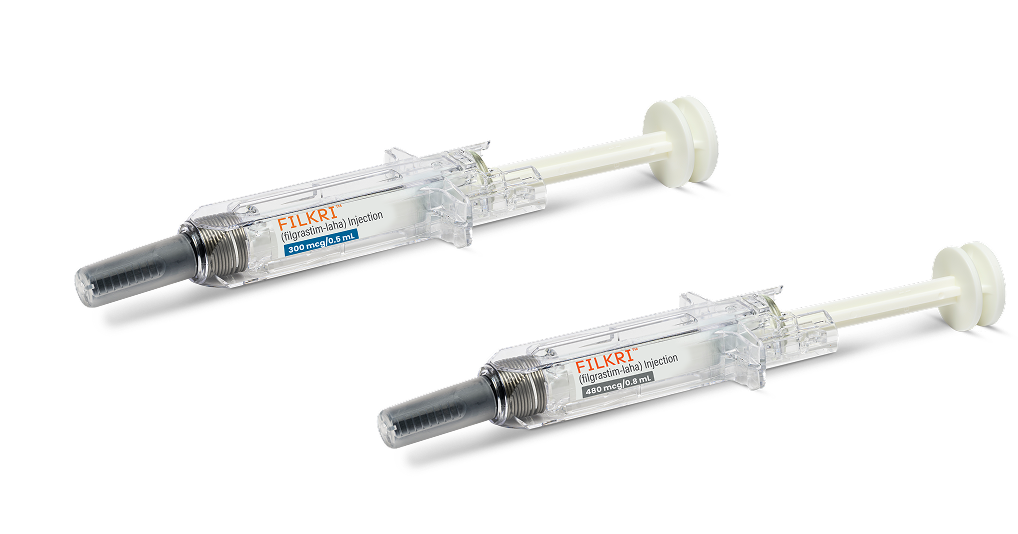
FILKRI is supplied as single-dose prefilled syringes for subcutaneous or intravenous use in 300 mcg/0.5 mL and 480 mcg/0.8 mL strengths.
For more information, please see the full Prescribing Information.
NEUPOGEN® (filgrastim) is a registered trademark of Amgen, Inc.